
Dear New Hartford CSD Parents and Guardians,
New York State requires school districts to inform parents and guardians of the emergency response protocols that will be implemented during emergencies and to provide appropriate training to staff and students on these procedures.
The New Hartford Central School District takes emergency preparedness and the health and safety of our students, staff, and school community very seriously. Because emergencies can involve unexpected events and rapidly changing circumstances, our schools prepare and train to respond to a wide range of situations, whether caused by natural events or human actions. While it is impossible to predict exactly how every emergency may unfold, our emergency response protocols are designed to provide clear guidance and enable us to respond quickly and appropriately to the circumstances at hand.
Our immediate priority during any emergency is the safety and well-being of our students and staff. Once appropriate safety measures are in place, we will provide families with timely and accurate information as circumstances allow. If an emergency requires students to be released to their families, parents and guardians will receive specific instructions regarding when and where to reunify with their child. We ask that families follow these instructions carefully to help ensure a safe and orderly reunification process.
During a school emergency, parents and guardians should not come to the school or campus unless specifically instructed to do so. The unexpected arrival of parents and guardians can create additional safety concerns, interfere with emergency response efforts, and impede the work of school staff and first responders.
Depending on the nature of the emergency, students may not be released until it is determined that doing so can occur safely. If reunification is necessary, families will receive clear instructions regarding the designated time and location. We ask that families follow these instructions carefully to help ensure a safe, secure, and orderly reunification process.
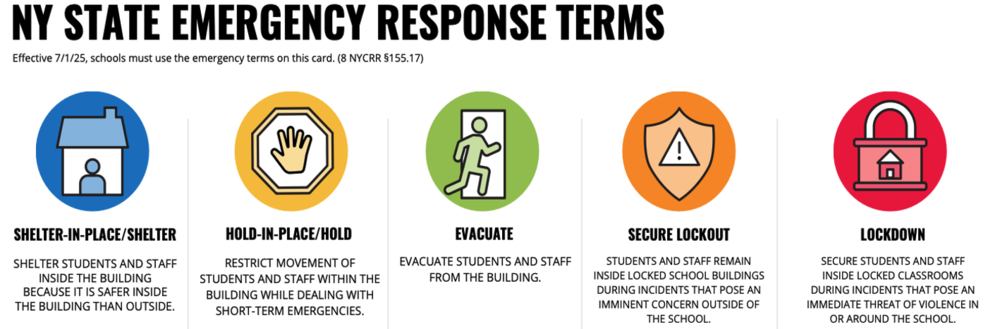
Emergency Response Terms:
New York State requires school districts to utilize established emergency response protocols based on the nature and circumstances of an emergency. Understanding these protocols and the terminology associated with them will help families know what to expect and better prepare you and your child should an emergency occur.
Shelter-in-Place / Shelter: Used when conditions outside or around the school make it safer for students and staff to remain indoors. Depending on the situation, individuals may be directed to move to a designated safe area within the building.
Hold-in-Place / Hold: Used when a situation within the school requires students and staff to remain in their current locations or limits movement throughout the building. Classroom instruction and other activities may continue as normally as possible.
Evacuate: Used when conditions require students and staff to leave the school building and move to a designated assembly area or alternate location.
Secure Lockout: Used when there is a potential threat or imminent safety concern outside the school. Students and staff remain inside the building, exterior doors are secured, and normal activities may continue inside when it is safe to do so.
Lockdown: Used when there is an immediate threat of violence in or around the school. Students and staff secure themselves in designated areas and remain there until released by law enforcement.
Emergency Preparation:
New York State requires schools to conduct emergency response drills throughout the school year. Each year, students and staff receive training on the procedures and expected actions associated with various emergencies. These procedures are reinforced through regularly scheduled drills so that students and staff are prepared to respond quickly and appropriately should an actual emergency occur.
During the school year, schools are required to conduct eight evacuation drills, four lockdown drills, and one early dismissal drill. School administrators may also conduct additional drills when necessary to reinforce procedures and support the continued safety and preparedness of our school community.
Emergency Drills and Preparedness Activities:
Evacuation Drills (e.g., fire drills)
Bus Evacuation Drills
Go Home Early Evacuation Drills
Shelter-in-Place, Hold-in-Place, Lockout, and Lockdown Drills
Evacuation to Alternate Site Drills
Trauma-Informed Drills:
New York State requires emergency drills involving students to be conducted in a trauma-informed, developmentally and age-appropriate manner. Drills will not include props, actors, simulations, or other tactics intended to mimic violence or an actual emergency. In accordance with New York State requirements, students and staff must be informed at the time a drill is conducted that the activity is a drill and not an actual emergency.
Safety Planning and Preparedness:
The New Hartford Central School District maintains comprehensive safety plans and procedures designed to support the prevention of, preparedness for, and response to emergencies.
District-Wide School Safety Plan: The District maintains a District-Wide School Safety Plan in accordance with New York State requirements. This public plan provides an overview of the District’s approach to emergency preparedness, prevention, response, and recovery. The plan is reviewed and updated annually and is available on the District website (click here).
Building-Level Emergency Response Plans: Each school maintains a Building-Level Emergency Response Plan specific to the needs, layout, and operations of that building. These plans contain detailed emergency response information and, for safety and security reasons, are confidential and not available to the public.
Crisis Response Plan: The District also maintains procedures to guide our response following a crisis or other significant event. These procedures focus on coordinating resources, supporting students and staff, communicating with families, and helping our school community safely recover and return to normal operations.
Threat Assessment Team: New this year, the District is developing a multidisciplinary Threat Assessment Team as an additional component of our comprehensive approach to school safety. This work is in progress and will focus on establishing a structured process to identify, assess, and respond to concerning behaviors or potential threats before they escalate.
Tabletop Exercises: Safety teams may use tabletop exercises as a training tool. These discussion-based activities allow staff to review emergency procedures, clarify roles and responsibilities, and work through potential emergency scenarios in a controlled setting.
Emergency Communication:
During an actual emergency, our immediate priority is to ensure the safety of our students and staff and to take the necessary actions to respond to the situation. Once appropriate safety measures are in place, we will communicate with families as quickly and accurately as circumstances allow.
ParentSquare is the District’s primary method of emergency communication. Depending on the nature and severity of the situation, important updates, instructions, and reunification information will be shared through ParentSquare. We strongly encourage families to rely on official District communications, as information and speculation shared through social media or other unofficial sources may be incomplete or inaccurate.
To ensure you receive timely and important District communications, please verify that the information on file for your family, including emergency contacts, is accurate and up to date.
Glossary:
Alternate Site: A designated location where students and staff may be relocated when the school building cannot be safely occupied.
First Responders: Law enforcement officers, firefighters, emergency medical personnel, and other public safety professionals who may respond to and assist during an emergency.
Incident Command: A structured system used by school officials and emergency responders to coordinate personnel, resources, communication, and decision-making during an emergency.
Reunification: A formal process initiated after a major incident when standard or early school dismissal procedures are not possible or appropriate. The goal of this process is to reunite students with their parents/guardians systematically. This process may take some time, but it is necessary to ensure that staff can accurately account for every student.
Trauma: means an emotional response to a deeply distressing or disturbing experience such as, but not limited to, an act of violence, natural disaster, abuse, neglect, or loss.
Trauma-informed: means an understanding of trauma and how it affects the physical, emotional, and mental health of students and adults.